
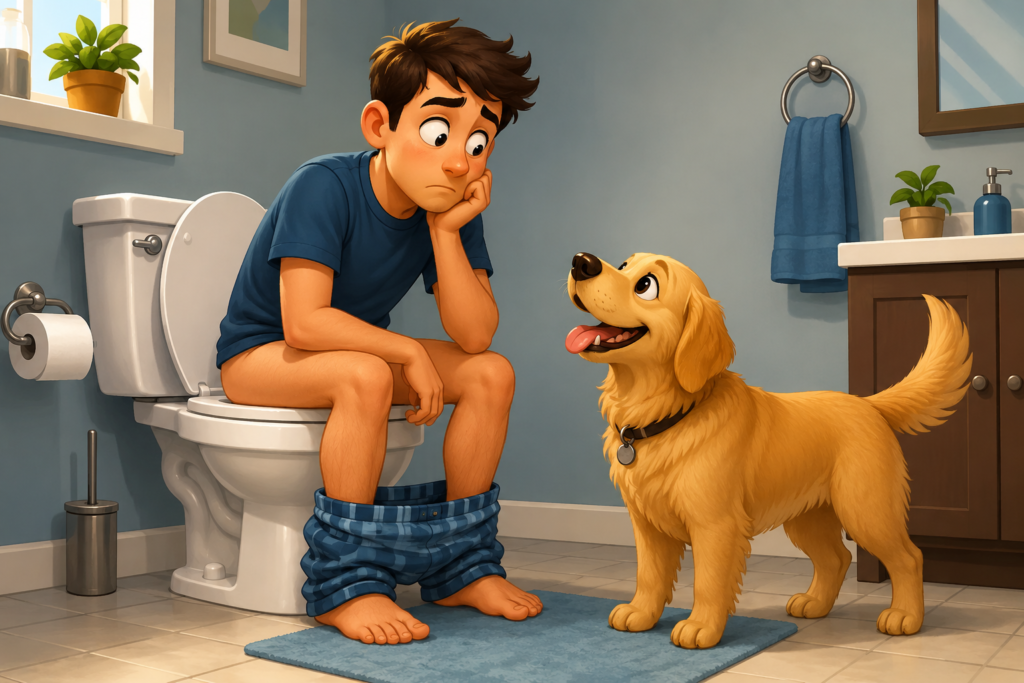
Have you ever noticed that your dog seems to follow you everywhere? 🐶❤️ You walk into the kitchen, and your dog follows. You move to the bedroom, and your dog is right behind you. You sit on the sofa, and your furry friend wants to sit next to you.
But one of the funniest things many dog owners notice is what happens when they go to the bathroom. 🚽😂
You quietly get up and walk toward the bathroom, and suddenly your dog gets up too. You enter the bathroom, and your dog follows you to the door. Sometimes the dog even tries to enter before you close the door. If you manage to close it, your dog may sit outside and patiently wait for you to come back.
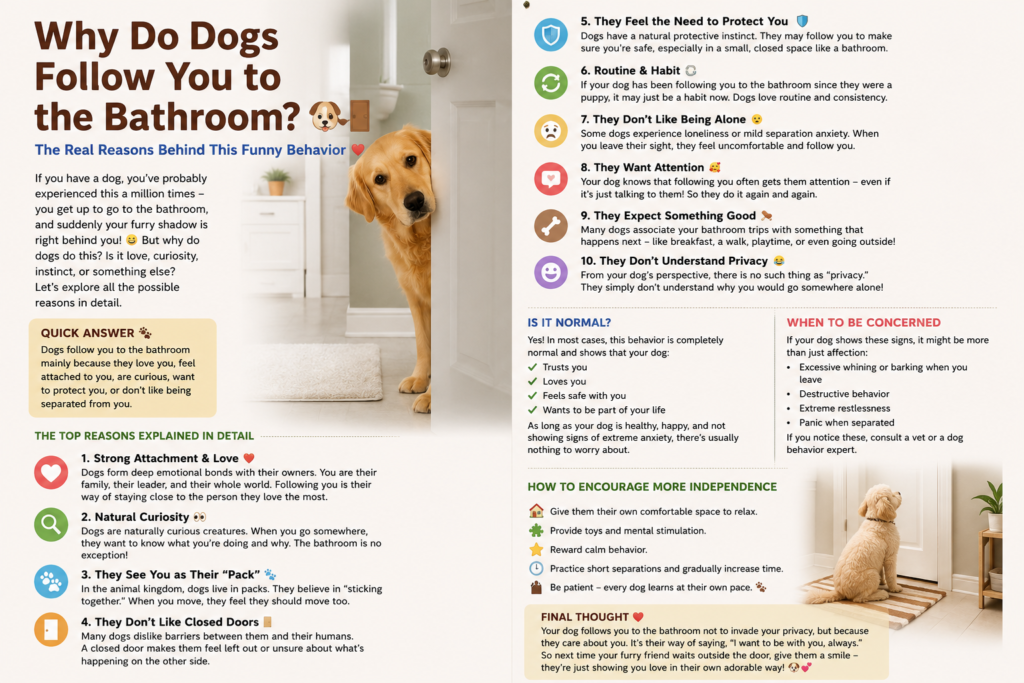
This can make many owners wonder:
**Why does my dog follow me to the bathroom?** 🤔🐕
Is your dog being protective? Is it curious? Does it hate being alone? Is it simply looking for attention? Or is there another reason behind this strange but adorable behavior?
The truth is that dogs can follow their owners for several different reasons. Their behavior can be connected to **attachment, curiosity, social instincts, routine, attention, security, and sometimes anxiety.**
In this article, we’ll explore the most common reasons dogs follow their owners to the bathroom and what this behavior can tell you about your relationship with your dog. 🐾❤️
## 🐕 1. Your Dog Is Strongly Attached to You ❤️
One of the simplest explanations is also one of the sweetest: **your dog may simply love being around you.**
Dogs are highly social animals. Unlike many animals that are comfortable spending most of their time alone, dogs often enjoy being around people and other animals.
When you become your dog’s primary caregiver, you can become an extremely important part of its daily life.
You provide food. 🍖
You provide water. 💧
You provide shelter. 🏠
You provide playtime. 🎾
You provide affection. ❤️
You take your dog outside. 🐕
And you provide a sense of safety.
Because of this relationship, your dog may naturally want to stay close to you.
So when you suddenly stand up and walk toward the bathroom, your dog may simply think:
**”My human is going somewhere. I want to go too!”** 🐾
There may be nothing mysterious about it.
Your dog isn’t necessarily interested in the bathroom itself. It may simply be interested in **you**.
—
## 👀 2. Dogs Are Naturally Curious
Dogs experience the world differently from humans.
They use their eyes, ears, nose, and other senses to understand what is happening around them. Their sense of smell, in particular, is incredibly important.
So whenever you get up and move somewhere, your dog may become curious.
You were sitting on the sofa a moment ago. Suddenly, you stand up.
Your dog notices.
You walk toward another room.
Your dog notices again.
You close a door.
Now your dog really wants to know what is happening! 😂🚪
This natural curiosity can encourage your dog to follow you.
The bathroom may not be particularly exciting to us, but your dog doesn’t understand human privacy in the same way we do.
From your dog’s perspective, you simply walked into another part of the house.
So why shouldn’t it follow?
—
## 🚪 3. Your Dog May Hate Closed Doors
This is one of the biggest reasons dogs wait outside bathrooms.
Many dogs don’t like closed doors between themselves and their owners.
Imagine what your dog experiences.
One second, you’re standing right there.
The next second, a door suddenly comes between you.
Your dog can smell you.
Your dog may hear you.
Your dog knows you’re nearby.
But it can’t see you.
That can create curiosity and, in some dogs, frustration.
Some dogs simply sit outside the door and wait. 🐶🚪
Others may scratch the door.
Some may whine.
Some may bark.
And some particularly determined dogs will try to push the door open!
😂🐾
This doesn’t automatically mean the dog has a behavioral problem.
Some dogs simply prefer having visual access to their favorite person.
—
## ❤️ 4. You Make Your Dog Feel Safe
For many dogs, their owner represents safety and comfort.
Your dog may feel relaxed when you are nearby.
This is especially noticeable during situations that make dogs uncomfortable, such as thunderstorms, fireworks, unfamiliar visitors, or strange noises. ⛈️🎆
If your dog regularly follows you around the house, it may be because your presence makes it feel secure.
Think about how dogs behave when they are sleeping.
Many dogs choose to sleep near their owners even when they have plenty of other places available.
Why?
Because being close to their trusted person can feel comfortable.
The same basic idea can apply when you go to the bathroom.
Your dog may simply prefer to know where you are.
To your dog, you aren’t just the person who fills the food bowl.
You are part of its safe environment. ❤️🐕
—
## 🐾 5. Dogs Are Social Animals
Dogs have a long history of living alongside humans.
They naturally pay attention to the behavior and movements of the people around them.
This social nature is one reason dogs often want to participate in family activities.
If everyone is sitting in the living room, your dog may stay there.
If everyone moves outside, your dog may want to go outside.
If you walk into another room, your dog may follow you.
And if you go to the bathroom…
Well, your dog may decide that this is another important family activity! 😂🚽🐶
Your dog doesn’t understand why this particular room should be off-limits.
It simply knows that **you went somewhere**, and it wants to stay connected to you.
—
## 🧠 6. Your Dog Has Learned Your Daily Routine
Dogs are surprisingly good at recognizing patterns.
They may learn what happens at different times of the day.
For example:
You wake up. ☀️
You go to the bathroom. 🚽
You prepare breakfast. 🍳
You drink coffee. ☕
You get ready for work. 👔
You leave the house. 🚗
Your dog may eventually learn this sequence.
Dogs don’t need a clock to understand routines. They can recognize repeated patterns through your movements, sounds, smells, and daily habits.
So when you get up and walk toward the bathroom in the morning, your dog may already know what comes next.
Maybe breakfast is coming. 🍖
Maybe it’s time for a walk. 🐕🦺
Maybe it’s playtime.
Your bathroom trip could simply be one part of a familiar routine.
—
## 🥰 7. Your Dog Wants Your Attention
Sometimes the answer is incredibly simple:
**Your dog wants attention.**
Dogs generally enjoy interacting with their owners.
They may follow you because they have learned that following you often results in attention.
You might talk to your dog.
You might pet it.
You might laugh.
You might look at it.
Even a simple “What are you doing?” can be rewarding for some dogs.
From your perspective, you’re just going to the bathroom.
From your dog’s perspective, following you could be another opportunity to interact with you.
If your dog gets attention every time it follows you, the behavior may become a regular habit.
—
## 🦴 8. Your Dog May Expect Something Good to Happen
Dogs are excellent at making associations.
Suppose you normally take your dog for a walk shortly after using the bathroom in the morning.
Your dog may eventually connect these events.
Bathroom → getting ready → walk. 🐕🌳
So when you get up and head toward the bathroom, your dog may think something exciting is about to happen.
It may not understand the bathroom itself.
Instead, it has learned that **your movement often predicts another activity.**
This is one reason dogs sometimes become excited when they see their owners putting on shoes, picking up a leash, opening a cupboard, or walking toward the kitchen.
Dogs constantly learn from repeated experiences.
—
## 😟 9. Separation Anxiety May Sometimes Be Involved
Following you everywhere does not automatically mean your dog has separation anxiety.
However, in some dogs, extreme attachment can be associated with anxiety.
A dog experiencing serious separation-related distress may become very uncomfortable when its owner leaves.
Possible signs can include:
* Excessive barking or whining 📢
* Destructive behavior
* Restlessness
* Pacing
* Attempts to escape
* Excessive distress when the owner leaves
* Difficulty relaxing when separated
If your dog simply follows you to the bathroom and then calmly waits outside, there may be nothing concerning about it.
But if your dog becomes extremely distressed whenever you disappear from sight, it may be worth paying closer attention.
A veterinarian or qualified animal behavior professional can help if the behavior seems severe or suddenly changes.
—
## 🛡️ 10. Is Your Dog Trying to Protect You?
Dogs can be very aware of their surroundings.
Some dogs naturally like to monitor where their owners are.
This can sometimes look like protective behavior.
For example, your dog may follow you into another room and then sit nearby.
It may look at the hallway.
It may listen to sounds outside.
It may remain alert.
However, it’s important not to assume that every dog following its owner is acting as a personal security guard. 😂🐕
Usually, the behavior is much simpler.
Your dog may just want to remain close to you and stay aware of what is happening around it.
Some dogs are naturally more watchful than others, depending on their individual personality and experiences.
—
## 🐶 11. Some Dogs Are Known as “Velcro Dogs”
Have you ever met a dog that seems almost impossible to separate from its owner?
These dogs are sometimes called **”Velcro dogs”** because they seem to stick to their humans everywhere they go. 😂❤️
A Velcro dog may:
* Follow you from room to room
* Sit at your feet
* Follow you into the kitchen
* Wait outside doors
* Sleep near you
* Watch you while you work
* Follow you to the bathroom
For these dogs, following you may simply be part of their personality.
They enjoy companionship.
They want interaction.
They feel comfortable when you’re nearby.
If you have a Velcro dog, you may eventually realize that going to the bathroom alone is no longer part of your life! 😂🚽🐾
—
## 🧬 12. Breed and Personality Can Influence the Behavior
Not all dogs behave the same way.
Some dogs are naturally independent.
They may happily spend time in another room while their owner is busy.
Other dogs are extremely people-oriented and prefer to stay close.
Breed characteristics can sometimes influence behavior, but individual personality matters too.
Two dogs of the same breed can have completely different personalities.
One might follow its owner everywhere.
The other might prefer sleeping peacefully on its bed.
Age can also make a difference.
Puppies may follow their owners because they are learning about their environment.
Older dogs may become more dependent on familiar people and routines.
Previous experiences, training, socialization, and the home environment can also influence how a dog behaves.
—
## 🏠 13. Your Dog May Simply Want to Know Where You Are
Dogs don’t always need a specific reason to follow their owners.
Sometimes they simply want to keep track of where their favorite person is.
You can think of it as your dog checking in.
You move to the kitchen.
Your dog follows.
You move back to the living room.
Your dog follows again.
You go upstairs.
Your dog follows.
You go downstairs.
Your dog is still behind you.
And finally, you head to the bathroom…
There it is again! 😂🐶
This can simply be a normal part of your dog’s social behavior.
Your dog may feel more comfortable when it knows where you are.
—
## 🚪 14. Why Does Your Dog Wait Outside the Bathroom?
Not every dog enters the bathroom.
Some simply sit outside and wait.
This can be especially funny because dogs sometimes look like they are guarding the door. 🛡️🐕
Your dog may be waiting because it knows you’ll come out soon.
It may also be waiting for you because it wants to continue whatever activity you were doing together.
If you were playing before you went to the bathroom, your dog may be ready to continue playing.
If you were preparing to go outside, it may be waiting for the walk.
Or it may simply be sitting there because being near you is its preferred place.
—
## 😂 15. Your Dog Doesn’t Understand Human Privacy
Perhaps the funniest explanation is that your dog doesn’t understand why you need privacy.
Humans have social rules about bathrooms.
Dogs don’t.
Your dog doesn’t think:
**”This is private time. I should respect the door.”** 😂
Instead, it may think:
**”My human went into that room. Why is there suddenly a door between us?”**
This difference between human and dog behavior explains why your dog may stare at you through the bathroom door with complete confusion.
To your dog, the situation probably makes perfect sense.
You are part of the same household.
So why shouldn’t it follow?
—
## 🐕 16. Your Dog May Be Checking That You’re Okay
Some dogs seem to keep a close eye on their owners.
If you suddenly move somewhere, your dog may follow because it has learned to pay attention to your movements.
Dogs can be very observant.
They may notice changes in your body language, voice, walking pattern, and routine.
This doesn’t mean your dog understands everything you’re doing.
But it does mean your dog is constantly gathering information about you and its environment.
So following you to another room can sometimes be a simple way of keeping track of what’s happening.
—
## 🧸 17. Your Dog May Have Nothing Better to Do
Let’s not forget another very simple possibility.
Your dog may just be bored! 😂🐶
If your dog doesn’t have enough physical activity, mental stimulation, toys, or interaction during the day, following you around the house can become an interesting activity.
You are moving.
You’re unpredictable.
You might go somewhere interesting.
Something might happen.
So your dog follows.
Providing appropriate exercise, play, training, and enrichment can help dogs stay mentally and physically engaged.
A tired and satisfied dog is often more comfortable relaxing independently.
—
## ❤️ 18. Following You Can Be a Sign of a Strong Bond
One of the nicest ways to look at this behavior is through the relationship between you and your dog.
Dogs form strong bonds with the people who care for them.
If your dog consistently chooses to stay near you, it may be showing that it enjoys your company.
The bathroom behavior itself isn’t necessarily special.
The larger picture is what matters.
Does your dog happily greet you?
Does it enjoy playing with you?
Does it relax around you?
Does it seek you out when it wants comfort?
Does it enjoy spending time with you?
If the answer is yes, then your dog’s bathroom-following habit may simply be one funny part of a healthy human-dog relationship. 🐶❤️
—
# ⚠️ When Should You Be Concerned?
Following you to the bathroom is usually not something to worry about by itself.
However, you should pay attention if the behavior is **sudden, extreme, or accompanied by other unusual changes.**
For example, if your dog was previously independent but suddenly becomes extremely clingy, restless, fearful, or unable to settle down, there could be an underlying reason.
A change in behavior can sometimes be associated with stress, environmental changes, aging, or health problems.
You don’t need to panic.
Simply observe your dog.
If you are concerned about a sudden or significant behavioral change, talk to a veterinarian. 🩺🐕
A professional can help determine whether the behavior is simply personality-related or whether something else needs attention.
also read this
# 🏡 How Can You Teach Your Dog to Be More Independent?
If your dog follows you everywhere and you want to encourage a little more independence, you don’t necessarily need to push it away.
Instead, gradually teach your dog that relaxing separately is safe and rewarding.
### 🛏️ Create a Comfortable Resting Area
Give your dog a comfortable bed or resting area where it can relax.
When your dog chooses to stay there calmly, reward that behavior with praise or an appropriate treat.
### 🧸 Provide Toys and Mental Stimulation
Interactive toys, puzzle toys, and appropriate chewing activities can give your dog something to focus on.
Mental stimulation is just as important as physical exercise for many dogs.
### 🐕 Encourage Calm Behavior
If your dog constantly demands attention, try to reward calm behavior instead of only responding when it follows you.
This can help your dog learn that it doesn’t need to be physically attached to you every second.
### ⏰ Keep a Healthy Routine
Regular meals, walks, playtime, training, and rest can help dogs feel more secure.
Predictability can make daily life easier for many dogs.
—
# 🐶 So, Why Does Your Dog Follow You to the Bathroom?
After looking at all these possibilities, the answer becomes clear:
**There isn’t one single reason why dogs follow their owners to the bathroom.**
Your dog may follow you because it:
❤️ Loves being near you
🐾 Feels safe with you
👀 Is curious about what you’re doing
🚪 Doesn’t like closed doors
🧠 Has learned your daily routine
🥰 Wants attention
🦴 Thinks something exciting may happen afterward
🐕 Has a naturally social personality
😟 Experiences some level of separation-related stress
😂 Or simply doesn’t understand the concept of human privacy!
The most important thing is to look at your dog’s **overall behavior**, rather than focusing on one funny habit.
If your dog is happy, healthy, relaxed, eating normally, playing normally, and behaving as usual, following you around the house is often simply part of its personality and relationship with you.
—
# 🐾 Final Thoughts: Your Dog Just Wants to Be With You ❤️
The next time you walk toward the bathroom and hear little paws following behind you, don’t be too surprised. 😂🐶
Your dog probably isn’t interested in the bathroom itself.
It may simply be interested in **you**.
To your dog, you’re a source of food, safety, comfort, companionship, routine, and affection.
You may see a bathroom trip as a private five-minute activity.
Your dog may see it as another opportunity to stay close to its favorite human. 🥰🐾
And when you close the door and find your dog sitting patiently outside, remember:
Your dog probably isn’t trying to invade your privacy.
It may simply be saying:
**”Where you go, I go.”** ❤️🐕
That’s one of the funny, sometimes annoying, but ultimately adorable things about living with a dog.
They don’t care whether you’re going to the kitchen, bedroom, garden, or bathroom.
If you’re their favorite person, they just want to know where you are.
So the next time your dog follows you to the bathroom, you might not need to ask, **”Why are you following me?”**
You may already know the answer:
**Because your dog loves your company.** 🐶❤️