
Online education has changed dramatically over the past decade. What was once viewed as an alternative to traditional college is now a mainstream way to earn an undergraduate or graduate degree while working, raising a family, changing careers, or living far from a university campus.
But choosing an online university is not as simple as searching for the school with the highest ranking. The best online university for one student may be completely different from the best choice for another. Cost, accreditation, degree availability, flexibility, student support, graduation outcomes, transfer policies, financial aid, and career preparation can all make a major difference.
#1
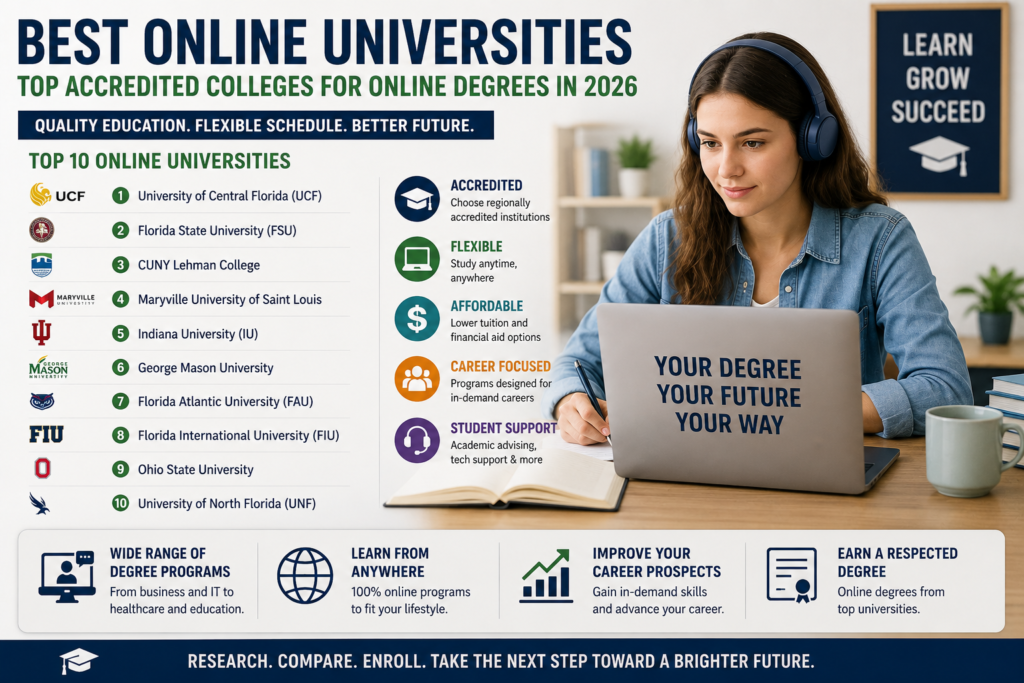
For 2026, several U.S. universities stand out for their online programs. Forbes Advisor’s 2026 ranking evaluated 3,676 accredited nonprofit colleges and used factors including affordability, student outcomes, credibility, student experience, and the application process. Its top online-college selections include the University of Central Florida, Florida State University, CUNY Lehman College, Maryville University of Saint Louis, Indiana University, George Mason University, and several other institutions.
At the same time, rankings should be treated as a starting point rather than a final decision. A university with an excellent overall online ranking might not offer the best program for your specific major. Before enrolling, students should verify accreditation, program requirements, total costs, course format, and whether the degree meets any licensing or professional requirements in their intended career.
This guide examines some of the best online universities in the United States, explains what makes them stand out, and provides a practical framework for choosing the right online college in 2026.
#2P
Image description: A realistic American college student studying online from a modern home office, using a laptop for a virtual university class while taking notes beside textbooks and a coffee mug.
Image-generation/search prompt: “Realistic editorial photograph of a diverse American college student studying for an accredited online university degree from a modern home office, laptop showing a generic virtual classroom, textbooks, notebook and coffee mug, natural daylight, professional U.S. education publication style, no university logos.”
Alt text: American student attending an online university class from home.
What Are the Best Online Universities in 2026?
There is no universally accepted single list of the “best” online universities because different rankings use different methodologies.
However, several institutions repeatedly stand out because they combine strong academic reputations with established online programs.
Some notable options include:
- University of Central Florida (UCF) — Best overall value
- Florida State University (FSU) — Strong graduation outcomes
- CUNY Lehman College — Attractive option for affordability and student debt
- Maryville University of Saint Louis — Strong online flexibility
- Indiana University — Broad academic offerings
- George Mason University — Strong public-university option
- Florida Atlantic University (FAU) — Affordable online education
- Florida International University (FIU) — Large selection of online degrees
- Ohio State University — Strong graduation outcomes
- University of North Florida — Established online bachelor’s options
Forbes Advisor’s 2026 analysis identifies UCF as its best overall value among its top online colleges, while FSU is recognized for its student graduation rate. CUNY Lehman College is highlighted for low average student debt, and FAU is selected as a leading affordable program.
The best choice for you, however, depends on your degree and personal circumstances.
1. University of Central Florida: Best Overall Value
The University of Central Florida is one of the strongest choices for students who want a large public university with an extensive online education infrastructure.
Forbes Advisor selected UCF as its Best Overall Value among its 2026 online college picks. The university offers more than 130 online programs and has decades of experience with distance learning.
UCF’s online offerings cover areas such as business, healthcare, public service, social sciences, humanities, and other disciplines.
One of the major advantages is scale. A large university can offer students access to a broad range of majors, academic resources, and support services.
However, students should check individual program requirements carefully because some programs may include internships, practicums, labs, or other in-person requirements.
Best for: Students seeking value, variety, and a large public university.
2. Florida State University: Best for Graduation Outcomes
Florida State University is another strong public-university option.
Forbes Advisor selected FSU as its Best Student Graduation Rate in its 2026 online college ranking. The ranking lists an overall graduation rate of 83% and an undergraduate retention rate of 96%.
Those figures don’t mean every online student will graduate at the same rate, but they provide useful context about the broader institution.
FSU can be particularly appealing to students who want a recognizable public university while maintaining the flexibility of online coursework.
Best for: Students prioritizing academic outcomes and public-university reputation.
3. CUNY Lehman College: Best for Lower Student Debt
CUNY Lehman College is part of the City University of New York system and offers another potentially attractive option for students focused heavily on affordability.
Forbes Advisor highlights Lehman for having the lowest average student debt among its selected schools.
For students who want to minimize borrowing, this is an important consideration.
The cheapest tuition isn’t always the lowest total cost, however. Students should compare tuition, fees, books, technology requirements, financial aid, and the number of credits required for graduation.
Best for: Cost-conscious students who want to minimize debt.
4. Maryville University of Saint Louis: Best for Online Flexibility
Maryville University is a private nonprofit university that has developed a significant online education presence.
Forbes Advisor’s 2026 ranking highlights Maryville for its low student-to-faculty ratio. The university also offers more than 200 programs across associate, bachelor’s, and master’s degrees, according to the ranking.
For working adults, the ability to study without attending traditional daytime classes can be particularly valuable.
However, private university tuition can be considerably different from public university tuition, so students should compare actual net prices after financial aid rather than looking only at published tuition.
Best for: Working adults seeking flexible online degree options.
5. Indiana University: Best for Academic Variety
Indiana University is another major institution worth considering when searching for an online degree.
Its large academic structure gives students access to a wide range of disciplines and degree pathways.
One advantage of choosing a major university is that you may have more options if you decide to change your academic direction later.
However, the quality and flexibility of online education can vary by program. Always evaluate the specific degree rather than assuming every program at the university operates identically.
Best for: Students who want broad academic options.
6. George Mason University: Strong Public University Choice
George Mason University is another prominent public institution included among Forbes Advisor’s top online colleges.
Forbes notes that George Mason has a strong admissions profile and offers respected online degree opportunities.
Its location in Northern Virginia also places the university near a major employment market, which can be attractive to students pursuing fields connected to government, technology, business, cybersecurity, and related industries.
For online students, however, location is less important than it is for traditional students unless the program includes in-person requirements or you intend to use local campus resources.
Best for: Students seeking a respected public university with career-oriented programs.
7. Florida Atlantic University: Best Affordable Option
Florida Atlantic University is another university that deserves attention from students looking for affordable online education.
Forbes Advisor selected FAU as its Best Affordable Program and reported an average in-state tuition rate of $4,879, with 71% of tuition covered by institutional aid on average in the methodology used for its ranking.
Because tuition and financial aid circumstances can change, prospective students should verify current costs directly with the university before making a decision.
Best for: Students prioritizing affordability.
8. Florida International University: Best for Online Degree Variety
Florida International University is a particularly interesting choice for students who want many online degree options.
Forbes Advisor’s public-university ranking identifies FIU as having the most online degree offerings among the schools evaluated in that list.
A broad selection can be valuable if you’re looking for a specialized major or want to compare several academic paths before committing.
Best for: Students who want extensive online degree choices.
9. Ohio State University: Strong Academic Reputation
Ohio State University is one of the country’s best-known public universities and also offers online education.
Forbes Advisor’s 2026 public-university ranking lists Ohio State among its top online public colleges and reports an overall graduation rate of 89%.
Students considering Ohio State should evaluate the specific online program, because not every major is available entirely online and some programs can include hands-on requirements.
Best for: Students who want a major public research university with strong institutional recognition.
10. University of North Florida: Flexible Public-University Option
The University of North Florida is another public institution included in Forbes Advisor’s 2026 online public-college ranking.
It offers online bachelor’s options and can be worth investigating for students looking for a public university with online degree-completion opportunities.
As with every university on this list, the right choice depends on the specific program rather than the university name alone.
Best for: Students looking for a public university with established online programs.
[IMAGE 2]
Image description: A clean comparison infographic showing major factors students should evaluate when choosing an online university: accreditation, tuition, financial aid, program availability, flexibility, graduation outcomes, student support, and career services.
Image-generation/search prompt: “Professional modern infographic comparing online university selection criteria, including accreditation, tuition, financial aid, degree availability, flexibility, graduation rate, student support and career services, clean U.S. higher education editorial design, highly readable typography, no logos.”
Alt text: Comparison of factors to consider when choosing an online university.
Why Accreditation Matters More Than a Ranking
Before comparing tuition or rankings, check accreditation.
Accreditation is one of the most important safeguards when evaluating an online university because it provides independent quality oversight.
The U.S. Department of Education does not directly accredit colleges. Instead, it recognizes accrediting agencies that it considers reliable authorities for evaluating higher education institutions and programs.
The Department maintains the Database of Accredited Postsecondary Institutions and Programs, which allows students to verify accreditation information.
This is especially important when researching schools that advertise themselves as “online universities.”
A professional-looking website doesn’t guarantee that a school is legitimate.
Before enrolling, verify:
- Institutional accreditation
- Accreditation status
- Whether the specific program has specialized accreditation
- Whether the degree qualifies for federal financial aid
- Whether the degree meets professional licensing requirements
- Whether credits will transfer to another institution
Programmatic accreditation can be particularly important in fields such as nursing, education, engineering, social work, and other regulated professions. Forbes Advisor notes that the importance of specialized accreditation varies by discipline and that some professional fields may require accredited programs for licensure.
How Much Does Online College Cost?
One of the biggest misconceptions about online education is that it is automatically inexpensive.
It isn’t.
Some online programs can be significantly more affordable than traditional campus programs, while others can cost as much or more.
Your total cost may include:
- Tuition
- Student fees
- Technology fees
- Books and course materials
- Software
- Exam fees
- Graduation fees
- Lab or clinical expenses
- Travel for required residencies
- Student loan interest
Don’t compare schools based only on the advertised price per credit.
Instead, determine how many credits you need and calculate the estimated total degree cost.
Also ask whether previous college credits will transfer.
A student who transfers 60 credits into a bachelor’s program may pay substantially less than a student who starts from zero.
Online vs. Traditional College: Which Is Better?
Neither is automatically better.
Online education can be an excellent choice for students who value flexibility.
It can allow you to:
- Continue working while studying
- Avoid relocating
- Study from home
- Reduce commuting
- Build a schedule around family responsibilities
- Access universities outside your immediate area
Traditional education can provide advantages such as:
- Face-to-face interaction
- Campus facilities
- In-person networking
- Residential college experiences
- Easier access to certain laboratories
- Structured daily schedules
The best format depends on your learning style and circumstances.
If you’re highly self-motivated and need flexibility, online education may be an excellent fit.
If you struggle with independent scheduling and learn best through direct classroom interaction, a traditional or hybrid format may be better.
What Types of Online Degrees Can You Earn?
Many online universities offer programs across a wide range of fields.
Common online bachelor’s degrees include:
Business
Business administration, accounting, marketing, finance, management, and entrepreneurship are among the most common online degree categories.
Computer Science and Information Technology
Online programs can cover computer science, information systems, cybersecurity, software development, data analytics, and related areas.
Healthcare
Students can find online programs in healthcare administration, public health, health information management, and certain nursing-related fields.
However, healthcare programs often include clinical or practical requirements that cannot be completed entirely online.
Education
Education degrees are widely available online, but teacher-certification requirements vary by state.
Psychology
Psychology is another popular online degree field, although students should understand that an online bachelor’s degree alone generally does not qualify someone to practice independently as a licensed psychologist.
Communications and Liberal Arts
Students can pursue online degrees in communications, writing, history, political science, sociology, English, and related disciplines.
Are Online Degrees Respected by Employers?
An accredited online degree can be respected by employers, particularly when it comes from a legitimate university and provides relevant skills.
In many cases, the diploma itself may not emphasize whether the coursework was completed online.
What matters more can include:
- Accreditation
- Institution reputation
- Degree relevance
- Skills
- Work experience
- Internships
- Portfolio projects
- Professional certifications
- Communication abilities
For certain careers, employers may also care about professional licensure or program-specific accreditation.
That’s why students should investigate the requirements of their target profession before enrolling.
How to Choose the Best Online University for You
Rather than copying someone else’s ranking, create your own shortlist.
Step 1: Choose Your Career Goal
Don’t start with the university.
Start with what you want to do after graduation.
For example:
“I want to become a cybersecurity analyst.”
Then identify degrees that can prepare you for that career.
Step 2: Find Universities Offering the Degree
Create a shortlist of five to ten schools.
Step 3: Verify Accreditation
Use the U.S. Department of Education’s accreditation resources to verify the institution.
Step 4: Calculate the Total Cost
Don’t stop at tuition.
Estimate the complete cost of completing the degree.
Step 5: Check Financial Aid
Compare scholarships, grants, institutional aid, federal aid eligibility, and payment options.
Step 6: Check the Course Format
Determine whether classes are:
- Fully asynchronous
- Live online
- Hybrid
- Self-paced
- Cohort-based
If you work full time, asynchronous courses may provide substantially more flexibility.
Step 7: Check Graduation and Retention Data
High graduation and retention rates can provide useful context, although they should not be interpreted as guarantees for individual students.
Step 8: Investigate Career Services
Look for:
- Internship assistance
- Resume support
- Career counseling
- Employer networking
- Alumni networks
- Job placement resources
Step 9: Check Transfer Policies
If you’ve already completed college coursework, ask exactly how many credits will transfer.
Step 10: Compare the Final Three
After researching everything, compare your three strongest options side by side.
[IMAGE 3]
Image description: A diverse group of American online university students participating in a virtual class from different home environments, with laptops displaying a generic video lecture and digital coursework.
Image-generation/search prompt: “Realistic editorial collage-style scene showing diverse American college students attending online university classes from home, laptops with generic virtual classroom interfaces, studying, taking notes and participating remotely, modern professional higher education publication aesthetic, no university logos.”
Alt text: Students participating in online university classes from home.
Are Online Universities Good for Working Adults?
Online universities can be especially useful for working adults.
Traditional college schedules often assume that students can attend classes during specific hours.
Online programs can provide more flexibility.
For example, an employee working from 9 a.m. to 5 p.m. might complete asynchronous coursework during evenings and weekends.
However, flexibility does not mean less work.
A three-credit online course can still require substantial reading, assignments, exams, projects, and participation.
Students should be realistic about the time commitment.
Before enrolling, ask:
How many hours per week will I realistically have available for school?
That answer can help determine whether full-time or part-time enrollment is appropriate.
What Are the Disadvantages of Online College?
Online education has major advantages, but it isn’t perfect.
Potential disadvantages include:
- Less face-to-face interaction
- Greater need for self-discipline
- Fewer traditional campus experiences
- Potential feelings of isolation
- Technology problems
- Limited access to certain physical facilities
- Possible in-person requirements for specific programs
Some students thrive online.
Others discover that they learn much better in person.
If possible, take a low-cost introductory online course before committing to a large degree program.
How to Avoid Online College Scams
Be cautious when a school promises:
- A degree in an unusually short period
- Guaranteed employment
- A degree with little or no coursework
- Guaranteed acceptance everywhere
- Extremely cheap credentials
- Academic credit based primarily on “life experience”
- Pressure to pay immediately
The U.S. Department of Education specifically provides resources for identifying diploma mills and verifying accreditation. It explains that accreditation is a voluntary quality-assurance process and warns students to research institutions carefully.
If a school makes extraordinary promises, verify everything independently.
Frequently Asked Questions
What is the best online university in the U.S.?
There is no single best university for every student. Forbes Advisor’s 2026 ranking identifies the University of Central Florida as its best overall value and also highlights Florida State University, CUNY Lehman College, Maryville University, Indiana University, George Mason University, and other institutions.
Are online degrees accredited?
Many are, but not all. Students should verify the institution and, when relevant, the specific program through recognized accreditation resources. The U.S. Department of Education maintains a database of accredited postsecondary institutions and programs.
What is the cheapest online university?
There is no single cheapest online university for everyone because tuition can depend on residency, transfer credits, financial aid, program, and enrollment status. Public universities may offer particularly attractive in-state rates, while private schools may provide substantial institutional aid.
Can I earn a bachelor’s degree completely online?
Yes. Many accredited universities offer bachelor’s degrees that can be completed entirely online, although certain fields may require internships, labs, clinical experiences, practicums, or other in-person requirements. Forbes Advisor notes that some online programs include such requirements even when most coursework is remote.
Are online degrees respected by employers?
An accredited degree from a legitimate university can be respected by employers. Your career outcomes will also depend on the degree field, skills, work experience, internships, portfolio, professional credentials, and the employer.
Can I get financial aid for an online degree?
Many accredited institutions participate in federal student aid programs, although eligibility depends on the institution, program, and student’s circumstances. Students should verify the school’s federal-aid eligibility and complete the appropriate financial-aid application.
Is an online college degree worth it?
For many students, yes. Online education can provide flexibility and access to degree programs without requiring relocation or a traditional campus schedule. Whether it is worth the cost depends on the degree, university, career prospects, total debt, and your individual goals.
How do I know if an online university is legitimate?
Verify its accreditation through recognized accreditation resources, investigate its graduation and financial information, review the actual degree curriculum, check the school’s contact information, and research the institution independently. The U.S. Department of Education provides an official accreditation database for this purpose.
Final Thoughts
The best online universities in 2026 aren’t necessarily the schools with the most impressive marketing or the highest position on a single ranking.
The best university is the one that combines legitimate accreditation, a strong program in your chosen field, reasonable total cost, flexible coursework, adequate student support, and a realistic path toward your career goals.
Universities such as the University of Central Florida, Florida State University, CUNY Lehman College, Maryville University, Indiana University, George Mason University, Florida Atlantic University, Florida International University, and Ohio State University are all worth investigating for different reasons. Current rankings provide a useful starting point, but your final decision should be based on the specific degree you intend to earn.
Most importantly, verify accreditation before enrolling. The U.S. Department of Education does not directly accredit colleges; instead, it recognizes accrediting agencies and provides resources that students can use to verify institutional and program accreditation.
Then compare the details that actually affect your future: total tuition, financial aid, transfer credits, course flexibility, graduation outcomes, career support, internship opportunities, and professional requirements.
Online college can be an excellent investment—but only when the degree, institution, and financial commitment make sense for your specific goals.
Important: Rankings, tuition, degree offerings, accreditation status, admissions requirements, and program formats can change. Always verify current information directly with the university and the U.S. Department of Education before enrolling or making financial decisions. This article is for general educational purposes and does not constitute individualized academic, financial, or career advice.
[…] Best Online Universities in 2026: Top Accredited Colleges for Online Degrees […]