
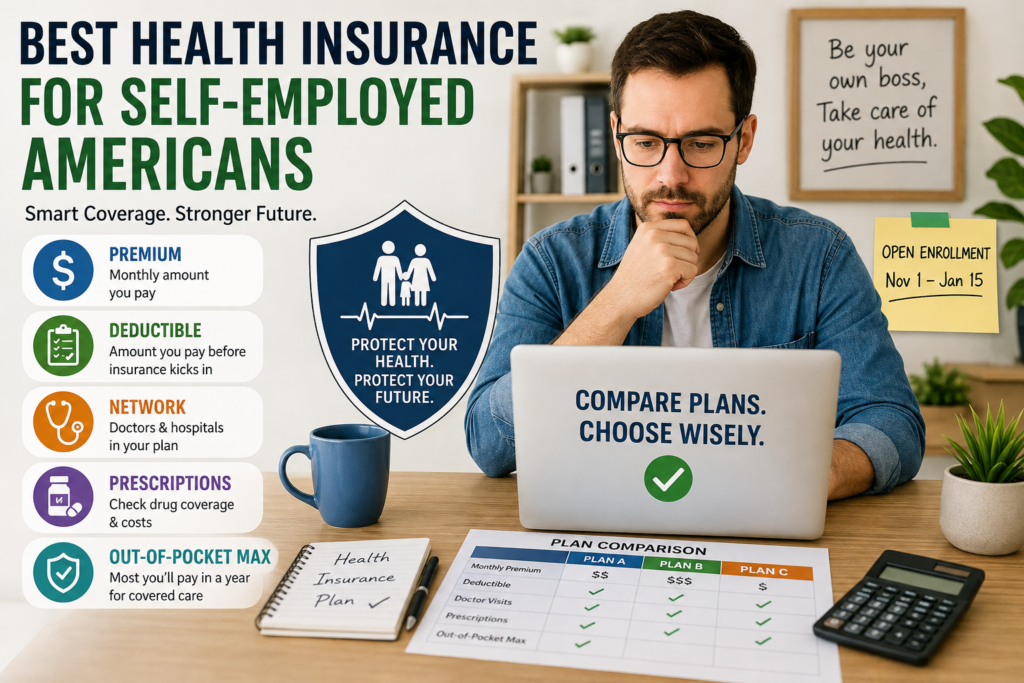
Being self-employed comes with plenty of freedom, but it also means handling benefits that an employer might otherwise provide—including health insurance. Freelancers, independent contractors, consultants, small-business owners, gig workers, and other solo entrepreneurs generally have to shop for their own coverage. The good news is that self-employed Americans have access to the same Affordable Care Act (ACA) Marketplace protections available to other individuals, including coverage for pre-existing conditions and essential health benefits. The challenge is figuring out which plan gives you the right combination of premiums, deductibles, provider access, prescription coverage, and out-of-pocket protection.
For most people who work for themselves without employees, the ACA Marketplace is the best place to start. HealthCare.gov specifically directs self-employed people with no employees toward individual Marketplace coverage, where they can compare plans and determine whether they qualify for financial assistance based on household income and family size. (HealthCare.gov)
However, there is no single health insurance company or plan that is automatically the “best” for every self-employed American. Insurance availability, premiums, provider networks, deductibles, and plan designs vary significantly by state, county, age, household size, and income. A plan that is an excellent choice for a healthy freelancer in Texas may be a poor choice for a self-employed parent in New York or a consultant who travels frequently between states.
This guide explains how self-employed workers can find the best health insurance in 2026, how Marketplace subsidies work, which plan types are worth considering, what to look for beyond the monthly premium, and how to avoid expensive mistakes.
[IMAGE 1]
Image description: A self-employed American working from a home office reviewing several health insurance plan options on a laptop, with documents and a calculator on the desk.
Image-generation/search prompt: “Realistic editorial photograph of a self-employed American freelancer at a modern home office comparing health insurance plans on a laptop, paperwork and calculator on desk, natural daylight, professional U.S. business publication style.”
Alt text: Self-employed worker comparing health insurance plans at home.
What Is the Best Health Insurance for Self-Employed People?
For most self-employed Americans who do not have employees, the best starting point is an ACA Marketplace plan. You can use the Marketplace to compare available individual and family policies and find out whether you qualify for a premium tax credit or additional cost-sharing assistance.
HealthCare.gov defines self-employed workers as people who run businesses that generate income but generally have no employees. Freelancers, consultants, and independent contractors can use the individual Marketplace for coverage. If your business has employees other than yourself or certain family members, different small-business options may become relevant. (HealthCare.gov)
The important point is that “best” does not necessarily mean the plan with the lowest monthly premium.
A better definition is:
The best health insurance plan is the one that provides the coverage you actually need at a total cost you can reasonably afford.
That total cost can include:
- Monthly premiums
- Deductibles
- Copayments
- Coinsurance
- Prescription costs
- Out-of-network expenses
- The annual out-of-pocket maximum
- Costs for specialists and ongoing treatment
- The financial impact of unexpected medical care
For someone who rarely visits a doctor, a lower-premium plan with a higher deductible may make sense. Someone who regularly takes prescription medications or sees specialists may be better off paying more each month for a plan with lower cost-sharing.
Best Health Insurance Options for Self-Employed Americans
The major options worth considering are ACA Marketplace plans, Medicaid when eligible, COBRA after losing employer coverage, and certain non-Marketplace options. However, these choices are not equally suitable for everyone.
1. ACA Marketplace Plans: Best Overall Starting Point
For many self-employed Americans, an ACA Marketplace plan is the strongest overall option because it combines comprehensive coverage with potential financial assistance.
Marketplace plans must cover 10 categories of essential health benefits, including physician services, hospitalization, prescription drugs, mental health services, and maternity care. ACA Marketplace plans also cannot generally deny coverage or charge someone more because of a pre-existing condition. (HealthCare.gov)
Depending on your income and circumstances, you may qualify for a premium tax credit that reduces your monthly premium. You may also qualify for cost-sharing reductions that lower certain out-of-pocket expenses when you use covered services.
The amount of financial assistance depends on factors such as household income and family size. The IRS explains that the premium tax credit is designed to help eligible individuals and families with low or moderate income afford Marketplace coverage. (IRS)
For self-employed workers, this can be especially important because income may fluctuate from month to month.
2. Medicaid: Best for Eligible Lower-Income Self-Employed Workers
If your income is low enough to qualify in your state, Medicaid can provide extremely affordable coverage.
Eligibility rules vary by state, and not every self-employed person with a low income will qualify under exactly the same rules. You can apply for Medicaid or CHIP throughout the year rather than waiting for the annual Marketplace Open Enrollment period. (HealthCare.gov)
For someone who qualifies, Medicaid may be substantially less expensive than purchasing a private Marketplace plan.
The downside is that provider networks and eligibility requirements vary by state, so you should verify that your preferred doctors, hospitals, and prescriptions are covered before making a decision.
3. COBRA: Useful After Leaving a Job, but Often Expensive
If you recently left a traditional job and lost employer-sponsored health insurance, COBRA may allow you to continue that coverage temporarily.
The major advantage is continuity. You may be able to keep the same doctors, network, and benefits you already had.
The major disadvantage is cost.
When you were employed, your employer may have paid a significant portion of your premium. Under COBRA, you generally have to pay the applicable premium yourself, potentially including an administrative fee.
For many newly self-employed workers, comparing COBRA with Marketplace coverage is therefore essential.
HealthCare.gov notes that losing job-based coverage can qualify you for a Special Enrollment Period, allowing you to enroll in Marketplace coverage outside the normal annual enrollment period. (HealthCare.gov)
4. Private Plans Outside the Marketplace
Some health plans may be available outside the ACA Marketplace. However, there is an important tradeoff: income-based premium tax credits are available only when eligible coverage is purchased through the Marketplace. (Healthcare Finder)
That means an off-Marketplace plan should not automatically be considered cheaper simply because its advertised premium is lower.
Compare the complete coverage—not just the sticker price.
How Marketplace Health Insurance Works for Self-Employed People
One of the biggest differences between being self-employed and working a traditional job is how income is estimated.
When you apply for Marketplace coverage, you generally provide your best estimate of your net self-employment income for the year in which you are receiving coverage. HealthCare.gov says Marketplace savings are based on estimated income for the coverage year rather than simply using the previous year’s income. (HealthCare.gov)
This matters because a freelancer could earn $3,000 one month and $8,000 the next.
Your income might also change because of:
- Seasonal work
- New clients
- Business expenses
- Contract losses
- Major projects
- Economic conditions
- Changes in business deductions
If your projected income changes substantially, update your Marketplace application. HealthCare.gov warns that if you ultimately earn more than you reported, you could have to repay some or all of the advance premium tax credits you received. (HealthCare.gov)
That makes accurate income tracking particularly important for freelancers and entrepreneurs.
2026 Health Insurance Subsidies: What Self-Employed Workers Need to Know
The financial assistance available through the ACA changed for 2026.
HealthCare.gov states that the additional Marketplace savings associated with the COVID-era enhanced premium tax credits ended on December 31, 2025. As a result, people who qualify for Marketplace savings in 2026 may pay more than they did previously. (HealthCare.gov)
This is one reason it is especially important to compare plans rather than automatically renewing an existing policy.
A plan that looked affordable in a previous year may no longer be the best value.
The Kaiser Family Foundation’s 2026 Marketplace calculator can provide estimates using 2026 premiums, income, age, family size, and other factors. However, KFF emphasizes that its calculator provides estimates and that actual eligibility and financial assistance are determined through the Marketplace or relevant state program. (KFF)
[IMAGE 2]
Image description: A clean infographic showing the major components of a health insurance plan: monthly premium, deductible, copay, coinsurance, and annual out-of-pocket maximum.
Image-generation/search prompt: “Professional U.S. healthcare infographic explaining health insurance costs with clearly labeled premium, deductible, copay, coinsurance, and out-of-pocket maximum, clean editorial design, easy-to-read visual hierarchy.”
Alt text: Infographic explaining the main costs of health insurance.
The Different ACA Metal Levels Explained
Marketplace plans are commonly organized into Bronze, Silver, Gold, and Platinum categories.
These categories are primarily about how you and the insurance company split the cost of covered care—not about the quality of medical care.
Bronze Plans
Bronze plans generally have lower monthly premiums but higher out-of-pocket costs when you receive medical care.
They may be attractive for:
- Healthy adults
- People who rarely see a doctor
- People primarily concerned with protection from major medical expenses
- People who want to minimize monthly premiums
The downside is that routine care and unexpected medical treatment can cost more before you reach the plan’s out-of-pocket limit.
Silver Plans
Silver plans occupy the middle of the spectrum and can be particularly important for people who qualify for cost-sharing reductions.
If you qualify for these additional savings, a Silver plan can potentially provide significantly better out-of-pocket value than simply choosing the cheapest premium.
For many moderate-income self-employed workers, Silver plans deserve especially careful consideration.
Gold Plans
Gold plans generally have higher premiums but lower cost-sharing when you receive covered care.
They can make sense if you:
- Visit doctors regularly
- Take expensive prescriptions
- Have predictable medical expenses
- Need frequent specialist care
- Prefer more predictable healthcare costs
Platinum Plans
Platinum plans generally have the highest premiums and lower cost-sharing.
They can make sense for people who anticipate substantial healthcare use and want to reduce their costs when receiving care.
However, the premium difference can be substantial, so you should compare the expected annual cost rather than assuming Platinum automatically provides the best value.
Premium vs. Deductible: Don’t Make This Common Mistake
A common mistake when shopping for health insurance is choosing a plan solely because it has the lowest monthly premium.
Suppose Plan A costs $250 per month and Plan B costs $400.
At first glance, Plan A appears to save $150 every month.
But imagine Plan A has a $7,500 deductible and Plan B has a $2,500 deductible. If you regularly need medical care, the cheaper premium could be offset by much higher out-of-pocket expenses.
The better question is:
“What could this plan cost me over an entire year?”
Consider both predictable and unexpected costs.
A useful comparison is:
Annual premium + expected medical expenses + prescription costs + potential out-of-pocket exposure
You cannot predict every medical event, but comparing these categories gives you a much more realistic picture.
What to Check Before Choosing a Plan
Before enrolling, look beyond the premium.
Check the Provider Network
Make sure your preferred doctors, hospitals, specialists, and healthcare facilities participate in the plan’s network.
A cheap plan is not necessarily a good deal if your preferred doctor is out of network.
Pay attention to whether the plan is an HMO, PPO, EPO, or another network structure because the rules for referrals and out-of-network care can differ.
Review Prescription Coverage
If you take regular medication, search the plan’s formulary before enrolling.
Check:
- Whether your medication is covered
- Which tier it occupies
- Whether prior authorization is required
- Whether you must use a particular pharmacy
- Whether generic alternatives are available
- How much you could pay
Prescription coverage can dramatically affect the real cost of a health plan.
Examine the Deductible
The deductible is the amount you generally pay for covered services before the plan begins paying according to its benefits, although some services may be covered before the deductible.
Don’t look at the deductible in isolation.
Compare it with the premium, copays, coinsurance, and out-of-pocket maximum.
Look at the Out-of-Pocket Maximum
This is one of the most important numbers on a health insurance plan.
The annual out-of-pocket maximum limits how much you have to spend on covered, in-network services under the plan’s rules during the plan year.
If you have a major medical event, this number can matter far more than whether the monthly premium is $50 higher or lower.
Review Specialist Costs
If you regularly see specialists, find out whether the plan requires referrals and how specialist visits are priced.
A plan that works well for someone who rarely sees a doctor may be less attractive to someone managing an ongoing condition.
How Self-Employed People Can Save Money on Health Insurance
There are several strategies worth considering.
Compare Marketplace Plans Every Year
Don’t automatically renew your existing plan without reviewing alternatives.
Premiums, provider networks, formularies, deductibles, and plan designs can change.
Your own circumstances may also change.
You may have:
- Higher or lower income
- A different household size
- Different doctors
- New prescriptions
- A new ZIP code
- Different healthcare needs
Rechecking your options annually can help prevent you from paying for a plan that is no longer competitive.
Keep Your Income Estimate Updated
Because Marketplace financial assistance can depend on your projected annual income, accurate estimates matter.
If your business suddenly takes off, update your Marketplace application rather than continuing to rely on an outdated income estimate. (HealthCare.gov)
Compare Total Annual Costs
Don’t compare only monthly premiums.
Instead, compare:
12 months of premiums + expected healthcare expenses + prescription costs + potential out-of-pocket exposure.
This simple approach can reveal that a plan with a higher monthly premium is actually cheaper for your particular circumstances.
Consider an HSA-Compatible Plan
If you are eligible for a Health Savings Account, an HSA-compatible high-deductible health plan may be worth considering.
HSAs can provide tax advantages, but eligibility rules and contribution limits apply. Because tax rules can change, confirm the current requirements before making a decision.
The strategy can be particularly appealing to self-employed individuals who are comfortable paying more out of pocket for routine care in exchange for lower premiums and potential tax advantages.
The Self-Employed Health Insurance Tax Deduction
Health insurance can have an additional tax consideration for self-employed workers.
The IRS says eligible self-employed individuals may be able to deduct qualifying health insurance premiums as an adjustment to income, subject to specific rules and limitations. The deduction can include coverage for the self-employed individual, spouse, dependents, and certain children under age 27. (IRS)
The deduction isn’t automatic in every situation.
For example, the IRS states that the deduction generally cannot exceed the earned income from the relevant trade or business, and special rules apply when an individual was eligible for an employer-subsidized health plan. (IRS)
The IRS currently directs taxpayers to Form 7206 to determine the amount of the self-employed health insurance deduction. (IRS)
If you receive a Marketplace premium tax credit, the interaction between the credit and the self-employed health insurance deduction can become complicated. It is therefore wise to keep detailed records and consult a qualified tax professional when necessary.
What If Your Income Is Unpredictable?
This is one of the biggest issues for freelancers.
A traditional employee might know almost exactly what their annual salary will be. A freelancer may not.
For example, a self-employed graphic designer might earn:
- $4,000 in January
- $7,000 in February
- $2,500 in March
- $10,000 in April
Annualizing one unusually strong month could produce an unrealistic estimate.
Instead, use realistic expectations based on previous earnings, current contracts, business expenses, and likely future revenue.
HealthCare.gov recommends making your best estimate and updating the Marketplace when circumstances change. (HealthCare.gov)
Keeping good bookkeeping records throughout the year can make this process much easier.
When Can Self-Employed Americans Enroll?
The standard Marketplace Open Enrollment period is generally November 1 through January 15 for HealthCare.gov, although state-specific rules and dates can differ. (HealthCare.gov)
Outside Open Enrollment, you may still be able to enroll if you qualify for a Special Enrollment Period.
Qualifying events can include:
- Losing job-based health coverage
- Getting married
- Having a baby
- Adopting a child
- Moving to a new qualifying location
- Losing certain other forms of coverage
HealthCare.gov provides specific eligibility and timing rules for each event. (HealthCare.gov)
Medicaid and CHIP applications can generally be made year-round if you qualify. (HealthCare.gov)
If you recently left a job to become self-employed, don’t assume you have to wait until the next Open Enrollment period. Losing qualifying job-based coverage may create a Special Enrollment Period.
Best Health Insurance Strategy for Different Types of Self-Employed Workers
There is no universal winner, but different situations call for different strategies.
Healthy Freelancer With Few Medical Expenses
A Bronze plan may be worth considering if your priority is keeping premiums relatively low while maintaining protection against major medical expenses.
Compare the deductible and out-of-pocket maximum carefully.
Self-Employed Parent With Children
A family Marketplace plan may provide a better overall solution than evaluating only the adult’s healthcare needs.
Look carefully at pediatric care, prescriptions, specialist access, emergency coverage, and the family out-of-pocket maximum.
Self-Employed Person With Regular Medical Care
A Silver or Gold plan may provide better value if you expect frequent healthcare use.
Don’t focus exclusively on the monthly premium.
High-Income Consultant
If you don’t qualify for substantial Marketplace assistance, compare available plans based on network quality, total annual costs, deductible, prescription benefits, and out-of-pocket protection.
Recently Laid-Off Worker Starting a Business
Compare COBRA with Marketplace plans immediately.
COBRA may offer continuity, while a Marketplace plan could potentially provide lower premiums or financial assistance depending on your household circumstances.
Common Mistakes Self-Employed People Should Avoid
Choosing the Cheapest Premium
The lowest premium can come with substantially higher healthcare costs.
Ignoring the Provider Network
Always verify your doctors and hospitals.
Forgetting About Prescriptions
A plan can look inexpensive until you discover that your medication has unfavorable coverage.
Underestimating Annual Income
Incorrect income estimates can affect your premium tax credit and potentially create a tax liability when you reconcile the credit.
Assuming Last Year’s Plan Is Still the Best
Insurance markets change. Review your options every year.
Buying a Plan Without Understanding Its Rules
Know how referrals, specialist visits, emergency services, deductibles, coinsurance, and out-of-network care work before enrolling.
[IMAGE 3]
Image description: A self-employed couple comparing two health insurance plans on a laptop, with a visual checklist showing premium, deductible, network, prescriptions, and out-of-pocket maximum.
Image-generation/search prompt: “Realistic editorial lifestyle photograph of a self-employed American couple comparing health insurance options on a laptop, paperwork showing premium and deductible comparisons, modern home office, professional healthcare finance publication aesthetic.”
Alt text: Self-employed couple comparing health insurance plan costs and benefits.
A Simple Method for Choosing the Right Plan
If you’re overwhelmed by dozens of options, use this process.
First, determine whether you qualify for Marketplace coverage and financial assistance.
Second, estimate your household income for the coverage year as accurately as possible.
Third, identify your expected healthcare needs.
Fourth, make a short list of plans that include your preferred doctors and hospitals.
Fifth, check prescription formularies.
Sixth, compare monthly premiums.
Seventh, compare deductibles, copayments, coinsurance, and out-of-pocket maximums.
Eighth, calculate a realistic best-case and worst-case annual cost.
Ninth, review the plan’s Summary of Benefits and Coverage before enrolling.
Finally, reconsider your decision if the plan has restrictive networks, unfavorable prescription coverage, or an out-of-pocket exposure that you could not comfortably afford.
Frequently Asked Questions
What is the best health insurance for a self-employed person?
For many self-employed Americans without employees, an ACA Marketplace plan is the best place to start because it offers comprehensive coverage and may provide income-based financial assistance. The best specific plan depends on your state, income, age, household size, doctors, prescriptions, and expected healthcare needs. (HealthCare.gov)
Can self-employed people get Obamacare?
Yes. Self-employed people who meet the applicable requirements can purchase individual coverage through the ACA Marketplace. Freelancers, consultants, and independent contractors without employees can generally use the individual Marketplace. (HealthCare.gov)
Can self-employed people qualify for health insurance subsidies?
Potentially. Eligible Marketplace enrollees may qualify for premium tax credits and, depending on their circumstances, additional savings on out-of-pocket costs. Eligibility depends on household income and other factors. (IRS)
Can I deduct health insurance premiums if I am self-employed?
You may be able to claim the self-employed health insurance deduction if you meet IRS requirements. The deduction is subject to specific rules, including limitations based on earned income and eligibility for employer-subsidized coverage. (IRS)
What happens if my freelance income changes during the year?
Update your Marketplace application when your expected annual income changes significantly. Marketplace savings are based on estimated income, and earning more than you reported can affect the amount of premium tax credit you ultimately qualify for. (HealthCare.gov)
Is COBRA better than Marketplace insurance?
Not necessarily. COBRA can be valuable when keeping your existing doctors and coverage is important, but it can be expensive because you may have to pay most or all of the premium yourself. If you lose employer coverage, compare COBRA with Marketplace options before deciding.
Can I get health insurance outside Open Enrollment?
Possibly. You may qualify for a Special Enrollment Period after certain qualifying life events, such as losing health coverage, getting married, having a baby, or moving. Medicaid and CHIP are available for eligible applicants throughout the year. (HealthCare.gov)
Should I choose Bronze, Silver, or Gold?
It depends on how you expect to use healthcare and whether you qualify for additional savings. Bronze plans often emphasize lower premiums and higher cost-sharing, while Gold plans generally involve higher premiums and lower cost-sharing. Silver plans can be particularly important when you qualify for cost-sharing reductions.
Final Thoughts
The best health insurance for self-employed Americans isn’t necessarily the cheapest plan or the most expensive plan. It is the plan that provides the right balance between monthly premiums, medical expenses, provider access, prescription coverage, and financial protection.
For most freelancers, independent contractors, consultants, and solo business owners, the ACA Marketplace is the logical starting point. It allows you to compare individual and family plans and determine whether you qualify for premium tax credits or other savings. (HealthCare.gov)
The biggest mistake is choosing coverage based solely on the monthly premium. Instead, evaluate the entire financial picture: deductible, copays, coinsurance, prescription costs, provider network, and annual out-of-pocket maximum.
Self-employed workers should also pay particular attention to income estimates. Because Marketplace financial assistance can be based on projected annual household income, significant changes in business income should be reported promptly. (HealthCare.gov)
Tax considerations matter, too. Eligible self-employed individuals may be able to deduct qualifying health insurance premiums, but the IRS rules can be complicated, especially when Marketplace premium tax credits are involved. (IRS)
Ultimately, the right strategy is to compare your actual options for your ZIP code and household rather than relying on a generic “best insurance company” list. Insurance availability and pricing are local, and the plan that wins for one self-employed American may be a poor fit for another.
Important: Health insurance rules, premiums, subsidies, provider networks, and tax regulations can change. The information above is general educational information, not individualized insurance, medical, or tax advice. Verify current plan details through the official Marketplace and consult a qualified professional for advice about your specific circumstances.